World Models Without Blind Search: INTACT Generates Actions Directly from Intent
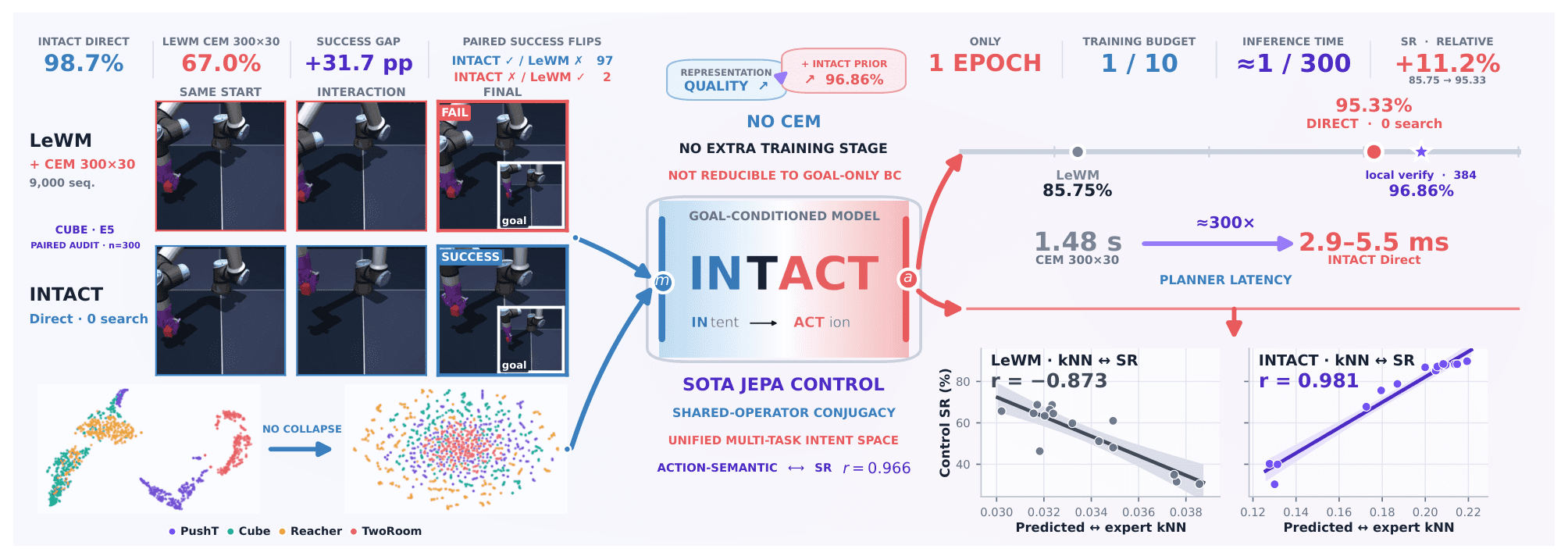
INTACT turns states, actions, and future outcomes in offline trajectories into a deployable intent-to-action interface, reaching a 95.33% average success rate without candidate search while cutting planning latency to roughly 1/300 of CEM 300×30.

World models can generate realistic synthetic data and predict future world states, helping robots develop spatial intelligence. They excel at answering one question: “What will happen next if the robot takes a particular action?”
At deployment time, however, mainstream world models still rely on “blind search”: methods such as CEM or MPPI sample large numbers of candidate action sequences, predict their outcomes one by one, and filter them to find a desirable action. As candidates are repeatedly sampled and evaluated, the model is reduced to a “judge” of proposed actions. The search adds latency, and the action knowledge inside the model cannot be read out directly—even though the training trajectories already contain the supervision needed for inverse control.
A typical LeWM configuration illustrates the problem: in a single planning cycle, CEM may evaluate 300×30, or 9,000, candidate sequences. This introduces substantial latency. Moreover, although a world model learns during training how actions change states, that knowledge is not exposed at deployment as a direct action-generation interface. A clear gap therefore remains between forward prediction and goal-directed control.
INTACT: 95.33% average success at 1/300 of the planning time
INTACT’s central idea is to use the states, actions, and future outcomes already present in offline trajectories, organizing latent motion intent into a semantic interface that an action model can read.
With this approach, a single-task INTACT model trained for only one epoch achieves an average success rate of 95.33% without any candidate-action search. Local verification with 384 candidates raises the result further to 96.86%. Planner-side inference in Direct mode takes 2.9–5.5 milliseconds, compared with approximately 1.48 seconds for conventional CEM 300×30—reducing planner-side latency to roughly 1/300.
01 From “predicting the consequences of actions” to “generating actions directly”
INTACT redesigns the interface between world models and action control.
A conventional world model primarily learns the following relationship:
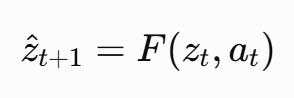
Put simply, the model predicts what will happen next from the robot’s current state and the action it is about to execute.
It is good at answering: “What will the world look like after this action is executed?”
But to control a robot, what we really need to know is: “What action should be executed now in order to reach the goal?”
Conventional methods do not usually learn this process directly. CEM or MPPI must first generate many random candidate actions, ask the world model to predict the outcome of each one, and then select the candidates that come closest to the goal. INTACT retains the world model’s ability to predict the future while adding an interface that can generate actions directly. From the difference between the robot’s current state and its target state, the model understands the change it should produce next and then generates an action plan with a clear direction toward the goal.
In other words, INTACT turns “blindly searching for actions” into “generating actions with a model”: the model proposes a direction first, and the world model then predicts, verifies, and corrects it.
02 The answer is already hidden in the trajectory
Consider a robot arm positioned to the left of an object. The arm pushes to the right, and the object moves right as a result. A conventional world model can use this experience to learn: “What will happen next after this action is executed?”
INTACT extracts an inverse question from the same experience: “If this is the motion change we want, what action should the robot execute now?” The two adjacent states immediately before and after the push record a change that actually occurred between neighboring states. INTACT calls this local intent:
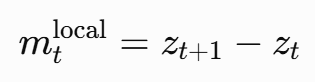
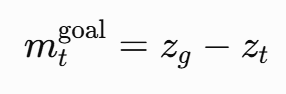
Because local intent comes from actions and outcomes that actually occurred, it tells the model which actions can genuinely produce a particular physical change from the current state. At the same time, a more distant future state in the same trajectory can serve as the state the robot ultimately wants to reach. The difference between the current state and this future goal is called goal intent:

Goal intent describes where the robot is now and where it ultimately wants to be.
The same trajectory therefore provides two complementary kinds of information: local intent tells the model what change an action actually caused, while goal intent tells it how to act now in pursuit of a future goal. INTACT turns the action experience already embedded in training trajectories into an action-generation capability that can be used directly at deployment, so the model no longer has to rediscover a direction by searching through large numbers of random actions every time.
03 Two forms of intent, one Predictor
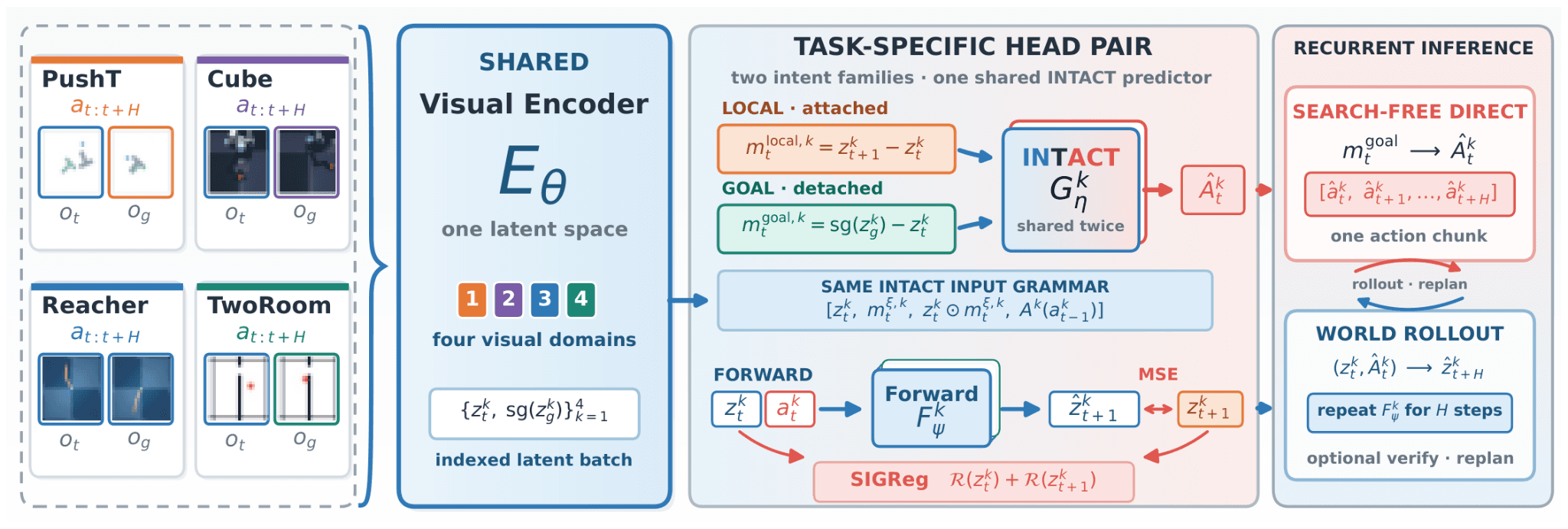
Local intent and goal intent describe two different kinds of change. Returning to the pushing example, local intent describes that “the object has just moved a short distance to the right,” a change caused by an action that actually occurred. Goal intent describes that “the object ultimately needs to reach the target position on the right,” which may require a longer and more complex sequence of motion.
INTACT therefore does not treat the final goal as if it were simply the robot’s next state, nor does it force the two forms of intent to become identical in latent space. At a particular moment, however, they may point toward similar actions. If the object is currently to the left of the goal, for example, the robot arm may need to push right first—whether the immediate purpose is to move it a small step rightward or the eventual purpose is to place it inside the target region on the right.
INTACT’s key design choice is to express local intent and goal intent through the same input interface and let the same INTACT Predictor interpret both.
The actions recorded in real trajectories act as a bridge: they gradually teach the model which real local changes and which future-oriented goals call for compatible control at the current state.
04 From goal intent to an executable action plan
Once training is complete, INTACT no longer begins by searching through random actions. The system first encodes the robot’s current observation and goal observation into the same latent space, producing a current state and a goal state. Their difference forms the goal intent at that moment:
The INTACT Predictor uses the current state and goal intent to generate the next action segment directly. The existing Forward Predictor then predicts the new state the robot may reach after executing that segment. From this predicted state, the system recomputes the difference to the goal and generates the next segment. Repeating this process produces a complete action plan directed toward the goal:
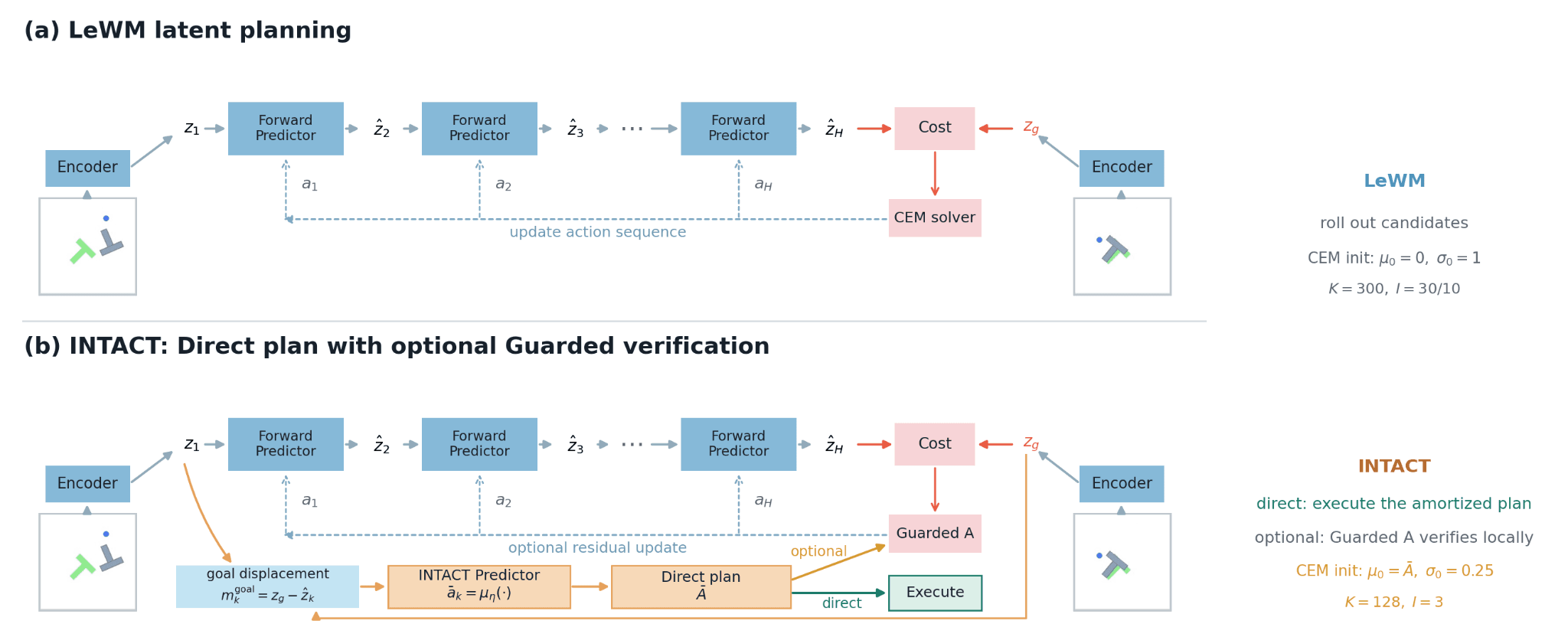
The INTACT Predictor and Forward Predictor therefore play distinct roles: the former proposes actions from the goal, while the latter predicts where those actions will take the world. Alternating between the two allows the model to construct a coherent path through latent space, step by step.
In Direct mode, this entire process samples no candidate actions and invokes no terminal cost function. After the model generates a plan, the robot executes only its first action chunk. It then obtains a new real observation, re-encodes the current state, and replans the next step. This closed-loop pattern—“execute a segment, observe once, and replan”—reduces the accumulation of error that can arise from depending on model predictions over a long horizon.
INTACT still retains search for tasks with more complex contact or a greater need for correction. But the search no longer starts from random actions. Instead, it stays near the generated Direct plan and performs only small-scale verification and adjustment. Search therefore has a different responsibility in INTACT: in the past, it had to find a direction among many random actions; now, the model generates the direction first, and search performs local verification and correction only when needed.
05 Behind the 95.33% result: search becomes optional
We evaluated INTACT on the four official LeWM tasks: PushT, Cube, Reacher, and TwoRoom. Each single-task model was trained from scratch for only one epoch—that is, one complete pass over the training data. In Direct mode, without sampling any candidate action sequences or invoking a terminal cost function, the four task success rates were:
- PushT: 85.78%
- Cube: 100.00%
- Reacher: 97.67%
- TwoRoom: 97.89%
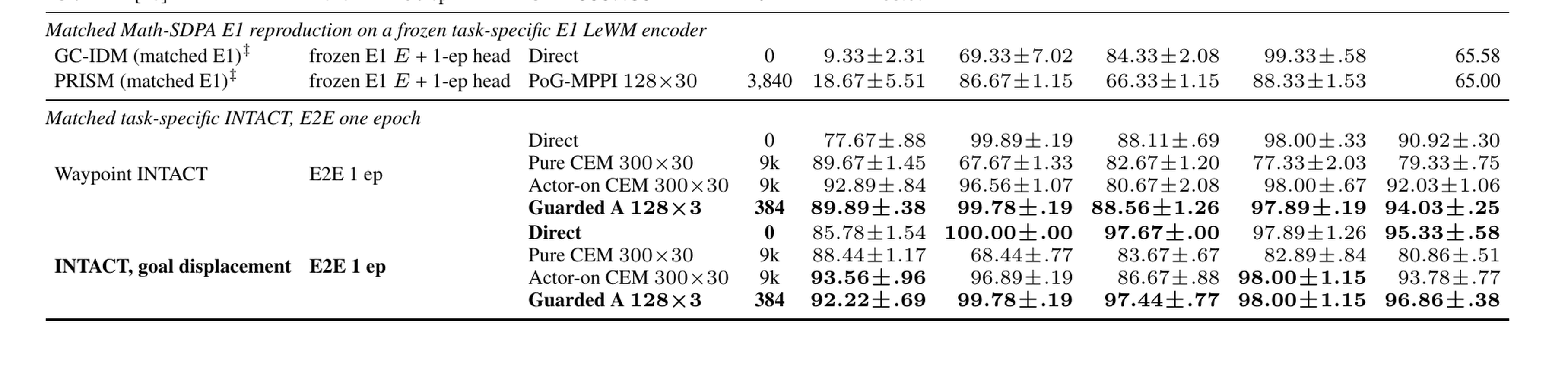
The average success rate across all four tasks was 95.33%. This means INTACT can directly generate an action plan with a clear direction from the current state and goal intent, without repeatedly testing large numbers of random actions at deployment.
More search does not necessarily produce better results
We further compared Direct mode with several search strategies. Starting from the action interface learned by INTACT, we enabled Actor-on CEM 300×30 to conduct a broad search over 9,000 candidate sequences. The average success rate across the four tasks was 93.78%, lower than the 95.33% achieved by Direct mode with no search. Once a model has learned to generate a coherent, goal-directed action plan, expanding the search space is not necessarily more effective. An overly broad search can drift away from the direction already learned by the model while reintroducing the cost of extensive prediction and filtering.
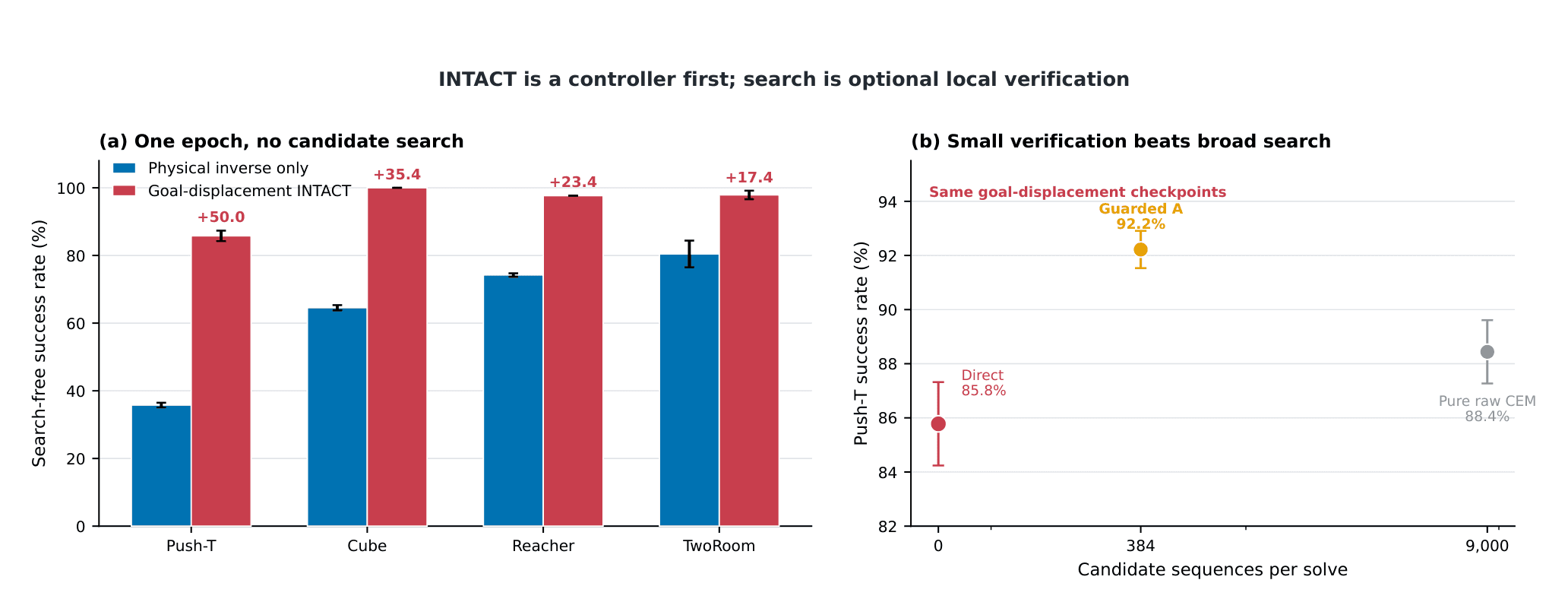
Small-scale verification around the Direct plan works better. Our proposed Guarded A centers its local search on the action plan already generated by the model and evaluates only 384 candidate sequences, raising the average four-task success rate to 96.86%. Compared with the conventional 9,000 candidates, this reduces the number of samples by a factor of 23.44 while achieving a higher success rate.
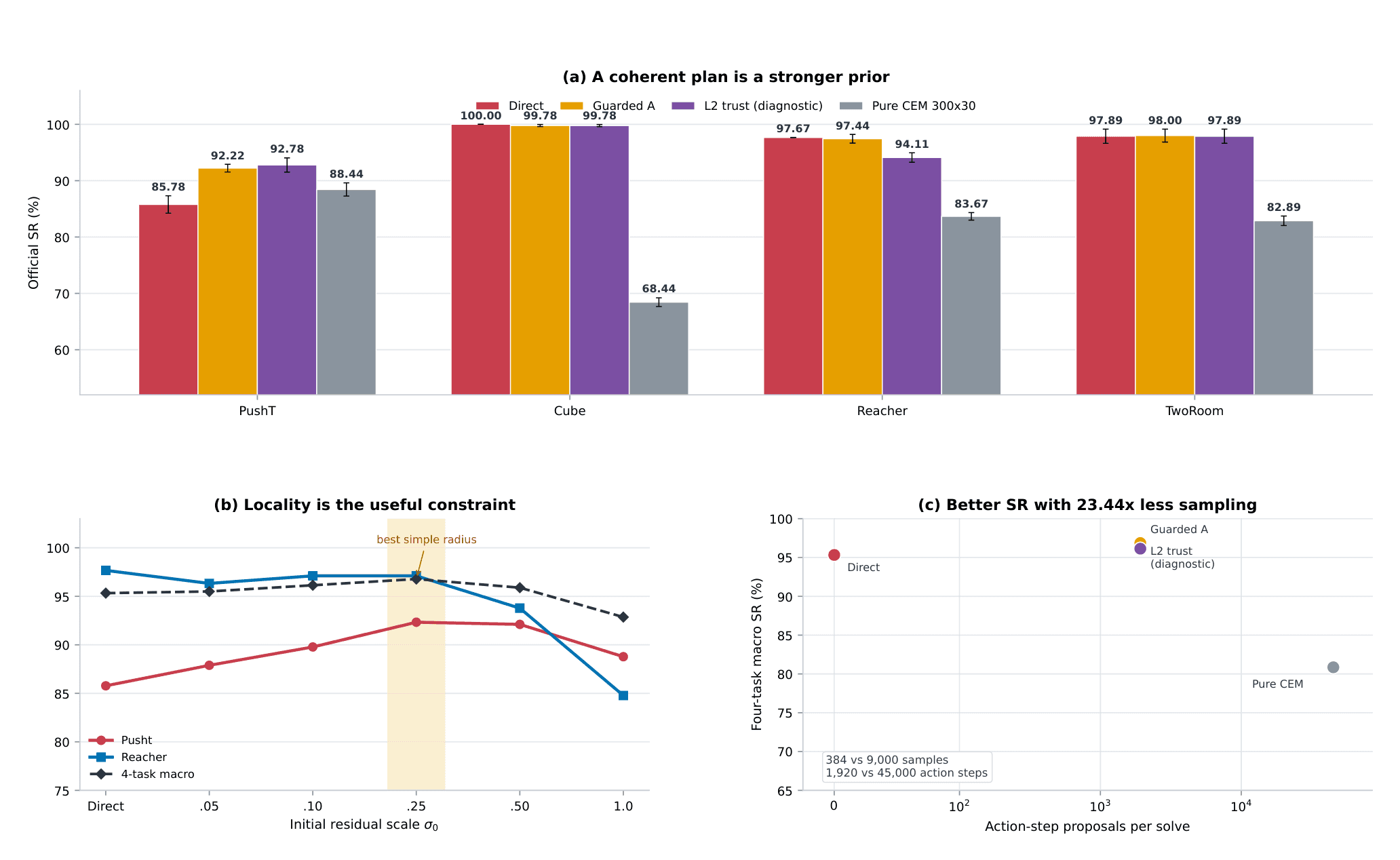
In other words, the key is not to search more actions, but to generate an action plan worth verifying in the first place.
Conventional world models rely on search to discover an action direction. INTACT generates the direction with the model first, then uses search for a small-scale check and correction only when necessary.
From seconds to milliseconds
Changing how actions are generated also reduces planning time dramatically. Planner-side measurements show:
- CEM 300×30: approximately 1.48 seconds
- INTACT Direct: approximately 2.9–5.5 milliseconds
Direct mode therefore reduces planner-side latency to roughly 1/300 of conventional CEM 300×30. These measurements cover action-planning inference, not the complete end-to-end delay from visual perception to physical execution. Even so, they show that the most expensive step in conventional world-model control—large-scale action search—has been compressed to the millisecond range. INTACT does not reject the value of search; it reassigns the responsibilities of the model and the search process. Search used to find the direction. Now the model generates the direction first, and search verifies and corrects it only when needed.
06 One visual encoder learns four tasks together
In the preceding single-task experiments, PushT, Cube, Reacher, and TwoRoom each trained their own visual model.
Real environments, however, rarely present a robot with only one task. This raises a broader question: can pushing an object, manipulating a cube, moving a robot arm, and navigating between rooms—four visibly different tasks—jointly train the same visual encoder?
In the multi-task experiment, INTACT lets all four tasks share the same Visual Encoder and Projector. Images from every task enter one encoder and are mapped into a common latent representation space. All four tasks therefore help shape the model’s visual understanding: where objects and goals are, how the scene has changed, and which visual differences actually matter for control are all learned by the same Encoder.
The tasks nevertheless have different action formats and dynamics. Pushing a T-shaped object across a plane clearly cannot use the same action output as controlling the joints of a robot arm. INTACT therefore does not force the different tasks into one concatenated action space. Instead, each task retains its own:
- Forward Predictor;
- action embedding;
- INTACT Predictor.
One way to understand the design is that the four tasks share a single “visual-understanding center” while retaining their own “action-execution systems.”
During training, the known task identity selects the corresponding control head, while data from all four tasks update the shared visual encoder. The model can thus learn common representations from diverse visual experience without conflating distinct action spaces.
One shared encoder improves all four tasks
After 5 epochs of training, the shared-encoder version of Goal-displacement INTACT reached an average four-task success rate of 89.39% in Direct mode.
Under the same shared-encoder setting, LeWM with CEM 300×30 achieved an average success rate of 66.17%.
The individual task results are shown below:
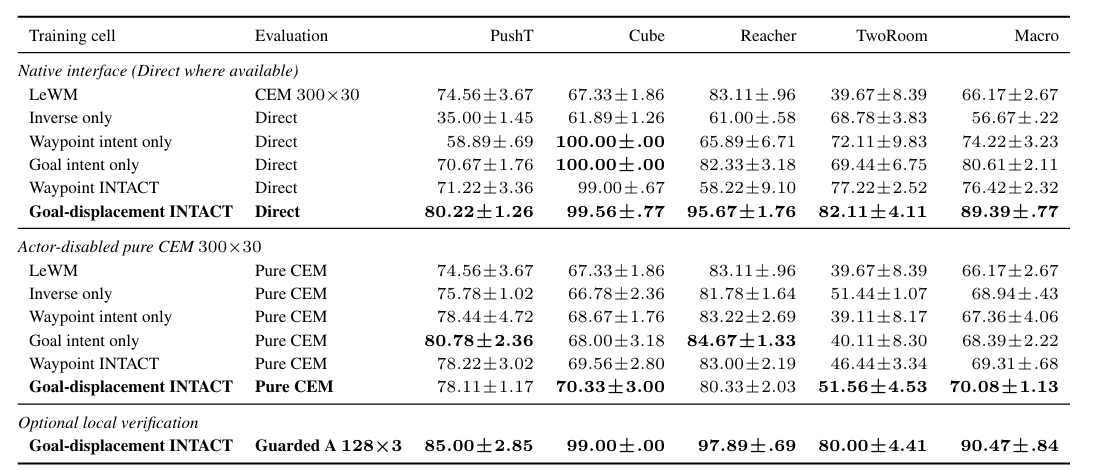
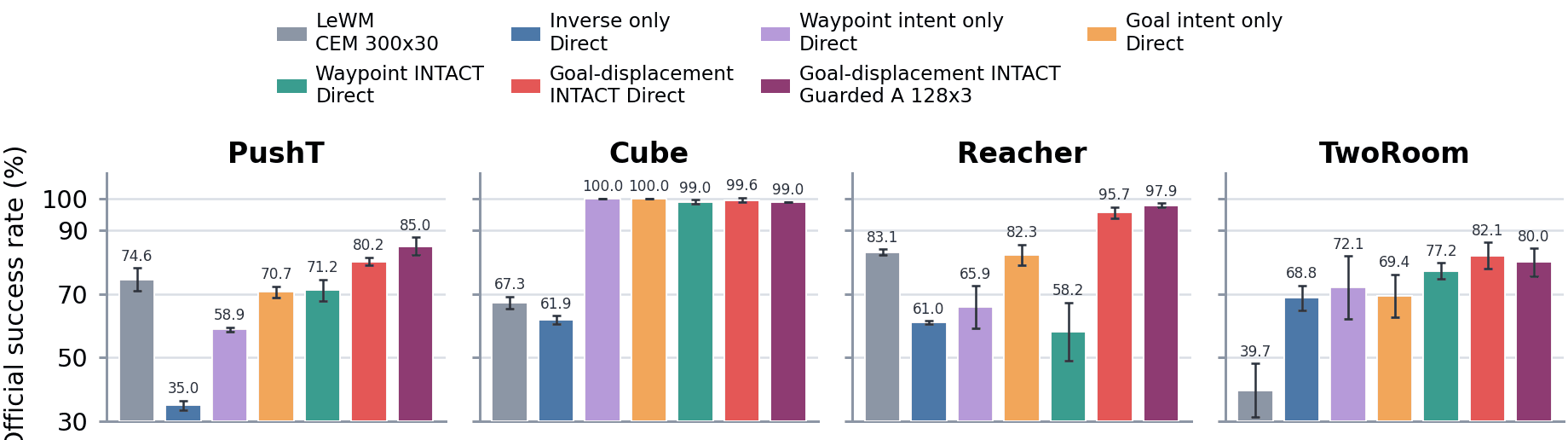
Shared INTACT improves particularly strongly on Cube and TwoRoom. This indicates that when action supervision and world-model learning are trained jointly, data from different tasks can help the Encoder learn visual representations better suited to control.
Local intent and goal intent remain indispensable in multi-task learning
The multi-task experiments further validate the two forms of intent introduced earlier. A model trained with goal intent alone achieved an average four-task success rate of 80.61%. Adding the physical anchor provided by real local state changes raised the complete INTACT model to 89.39%, an average improvement of 8.78 percentage points.
Learning only “how to act toward a goal” is therefore not enough. The relationship between real adjacent states and actions still helps the shared encoder understand:
- which state changes are physically achievable;
- which visual differences affect action selection;
- which goal-directed actions are grounded in real dynamics.
In other words, goal intent tells the model where to go, while local intent helps it understand which actions are physically feasible. Training on both is necessary to form a more stable control representation across tasks.
Search remains only the final local check
With the shared encoder, INTACT Direct already achieves an average success rate of 89.39%. Adding small-scale Guarded A verification around the Direct plan raises it to 90.47%, an improvement of only about 1.08 percentage points.
This leads to the same conclusion as the single-task experiments: once the model can generate reliable actions directly from goal intent, search is most valuable as a final local verification step rather than as a way to discover a direction from scratch.
07 Ablation: the gains remain when the action model is disabled
As shown above, the most immediate benefit of adding an action-generation module to a conventional world model is less search. But INTACT’s contribution goes beyond the deployment interface.
During training, the actions output by the INTACT Predictor are compared with the actions recorded in the trajectory. The resulting action error trains the action model and also propagates back into the visual encoder. In effect, it imposes an additional learning requirement on the Encoder:
When compressing an image, it must preserve not only the information needed to predict the future, but also the information that genuinely affects the robot’s choice of action.
Consider again a robot arm pushing an object. Two images may look almost identical: in one, a tiny gap remains between the arm and the object; in the other, the arm has already made contact. This subtle difference may not stand out when predicting the overall appearance of a future frame, but for control it can determine whether the arm should keep approaching or begin to push.
Through real “state–action–outcome” relationships, local intent encourages the model to retain information about physical contact and action recoverability. Goal intent further makes the current-state representation directly useful for goal-directed action generation. Action supervision therefore trains not only a new control interface but also reshapes the world model’s latent representation.
To test whether the improvement comes only from the new INTACT Predictor, we completely disabled the action model during evaluation and retained only the original Encoder, Forward Predictor, and CEM.
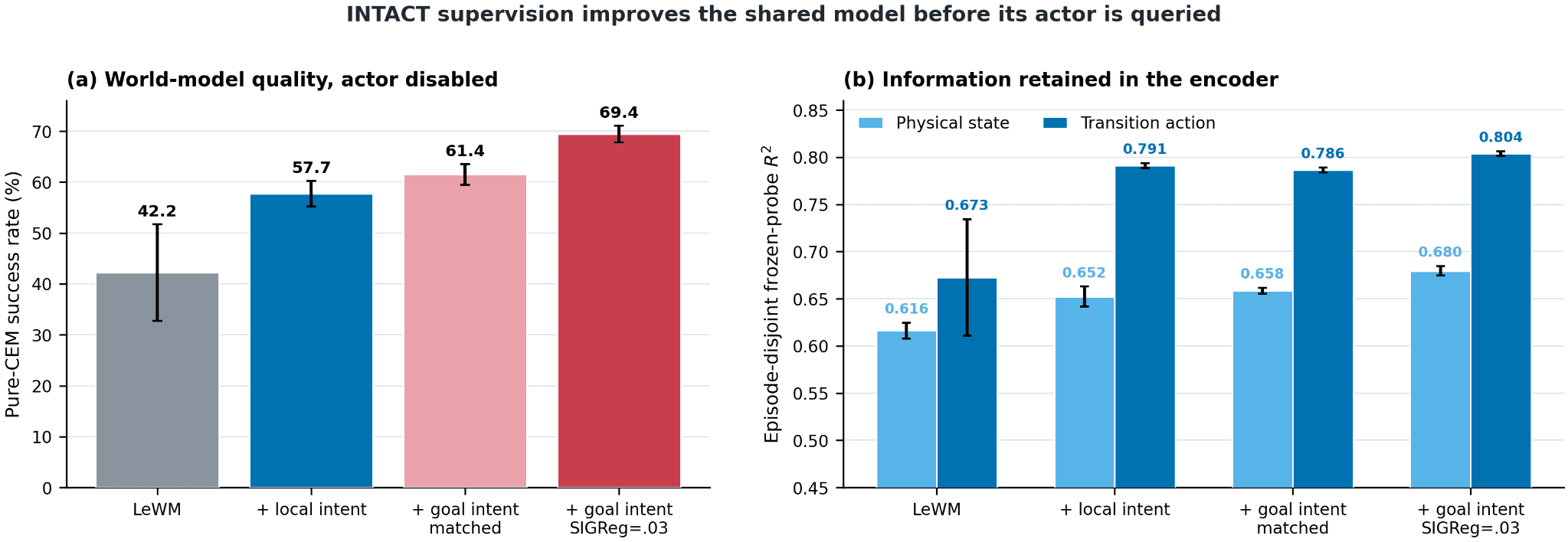
In the four-task shared-encoder experiment, using the same Pure CEM 300×30 planner increased the average four-task success rate from 66.17% for LeWM to 70.08% for Goal-displacement INTACT. Because the INTACT Predictor did not generate any actions in this evaluation, the gain can only come from the jointly trained visual representation and Forward Predictor.
The single-task PushT experiment shows a similar pattern. As local-intent and goal-intent supervision are added, the Pure CEM success rate increases from 42.2% to 57.7%, 61.4%, and 69.4%, even with the action model disabled. Frozen-probe experiments further show that more physical-state and transition-action information becomes readable from the encoder.
These results show that INTACT’s improvement has two connected components: it enables the model to generate actions directly from goal intent, and its action supervision also teaches the world model to emphasize state information that genuinely matters for control.
08 Limitations of INTACT
The current INTACT experiments are based primarily on four simulated tasks—PushT, Cube, Reacher, and TwoRoom—using fixed goal images and offline expert trajectories for training and evaluation. Although the multi-task model shares one visual encoder, each task still retains its own Forward Predictor and action-control head. It is therefore not yet a general controller that can switch freely across tasks and robot embodiments.
The intent-to-action relationship learned by INTACT also remains dependent on the experience covered by the training trajectories. The current method has not yet been validated on goals far outside the demonstration distribution, complex visual distractions, or the richer contact and dynamic variation found on real robots. As an action plan unfolds, the model also begins to use its own predicted latent states, so long-horizon prediction can still accumulate error.
In addition, Direct mode currently outputs the mean of the action probability distribution. When a scene admits several valid actions—for example, choosing different paths at a junction or selecting among multiple valid maneuvers during a contact transition—the mean can sometimes fall between several correct actions. Future work could explore multimodal action models, uncertainty-driven automatic verification, and more flexible local-search mechanisms.
What INTACT demonstrates at this stage is that, within the task coverage of offline trajectories, a world model can learn a deployable intent-to-action interface that turns large-scale search from a requirement into optional verification.
Moving from simulation to real robots, from fixed goals to out-of-distribution scenarios, and ultimately toward a unified action interface across tasks and embodiments remain important directions for future work.
09 Related links
The INTACT paper, project website, and code repository are now publicly available. We welcome more researchers and developers to test, discuss, and extend the work as we explore how world models can move from prediction to action.
- Paper: INTACT: Isomorphic Intent-to-Action Learning for Search-Free World Models (arXiv: https://arxiv.org/abs/2607.26056)
- GitHub: https://github.com/Roboparty/INTACT-JEPA (if you find it useful, a star is always appreciated 🌟)
- Project page: https://zju3dv.github.io/INTACT-JEPA/